ABOUT
CAH

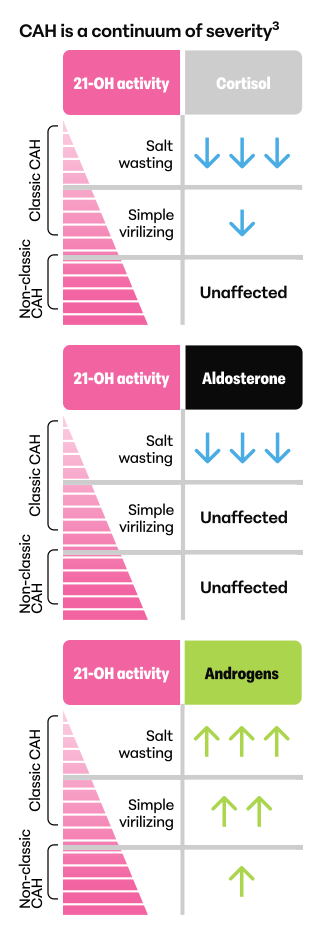
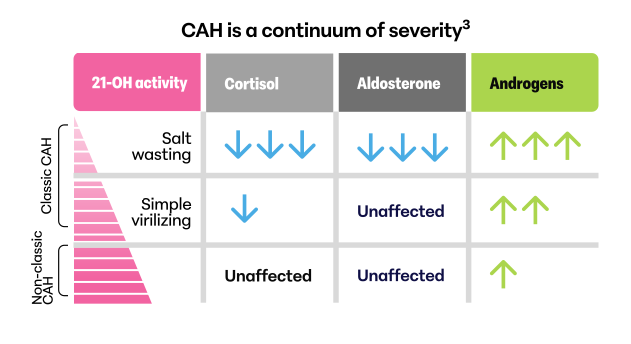
THE CAH CONTINUUM REFLECTS THE RANGE OF 21-OH DEFICIENCY1

Congenital adrenal hyperplasia, or CAH, is a group of disorders that affect the adrenal glands.1

Approximately 95% of CAH cases are caused by 21-hydroxylase (21-OH) deficiency, but the amount of residual enzyme activity varies.2,3

As a result, the hormonal imbalances and phenotypes vary too. Regardless of the degree of 21-OH deficiency, patients with all types of CAH experience overproduction of adrenal androgens.1

CAH is a continuum of severity chart

The common denominator in CAH is excess adrenal androgens3

Newborn screening for CAH is essential but imperfect

Endocrine Society recommends 2-tier screening to detect CAH

  • First tier: 17-OHP levels in dried blood spots2
  • Second tier: LC-MS/MS or cosyntropin stimulation if 17-OHP levels are >1000 ng/dL in the first screening3,4*
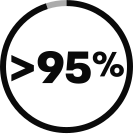
Greater than 95% reduction in false positives using first- and second-tier screening chart

reduction in false positives using first- and second-tier screening vs first-tier screening alone5†

Relying on first-tier screening can lead to false positives, particularly in premature and sick newborns who often have elevated 17-OHP levels5†

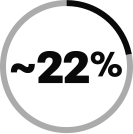
Approximately 22% false negatives with first tier screening percentage chart

false negatives with first-tier screening6

A negative first-tier screen does not rule out CAH. A second-tier screen should be conducted, especially for infants or children with atypical genitalia, accelerated growth, or symptoms of adrenal crisis.6

*Most patients with CAH have levels >5000 ng/dL.3,4

†In this study, false-positive rates (false positives/total screened) decreased from 0.75% with first-tier screening to 0.04% after second-tier screening.5

17-OHP=17-hydroxyprogesterone; LC-MS/MS=liquid chromatography with tandem mass spectrometry.

Cortisol deficiency leads to adrenal
androgen excess1,7

Because of 21-OH deficiency, adrenal glands cannot make enough cortisol and, in many cases, aldosterone. This leads to:

  • Loss of negative feedback in HPA axis
  • Increase in CRF secretion
  • Increase in CRF1 receptor activation
  • Increase in ACTH release
  • Overproduction of adrenal androgens

HPA Axis Physiology: Negative Feedback
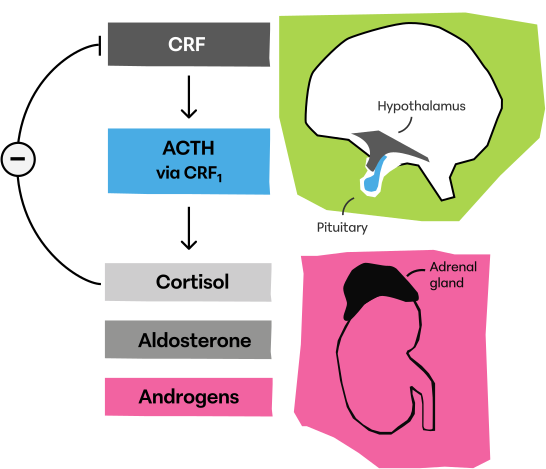
Graphic showing hypothalamic-pituitary adrenal axis normal cortisol levels functioning steroid production pathway

HPA Axis Pathophysiology in Classic CAH: Loss of Negative Feedback
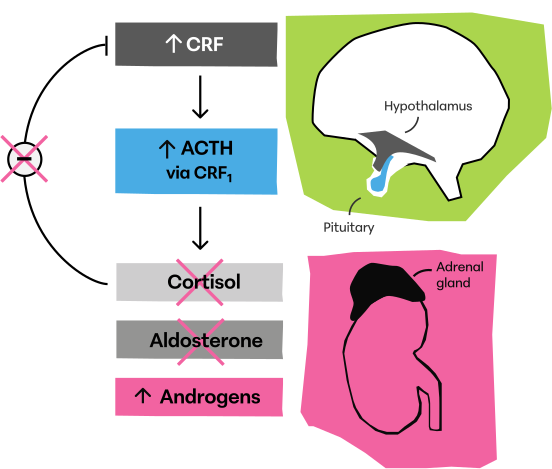
Graphic showing hypothalamic pituitary adrenal axis lack of cortisol leading to overproduction of CRF and adrenal androgens

The loss of negative feedback in the HPA axis increases secretion of CRF—a primary regulator of the HPA axis—from the hypothalamus. CRF then binds to CRF1 receptors in the pituitary glands and increases ACTH release, leading to excess adrenal androgens.1,7

ACTH=adrenocorticotropic hormone; CRF=corticotropin-releasing factor; CRF1=corticotropin-releasing factor type 1.
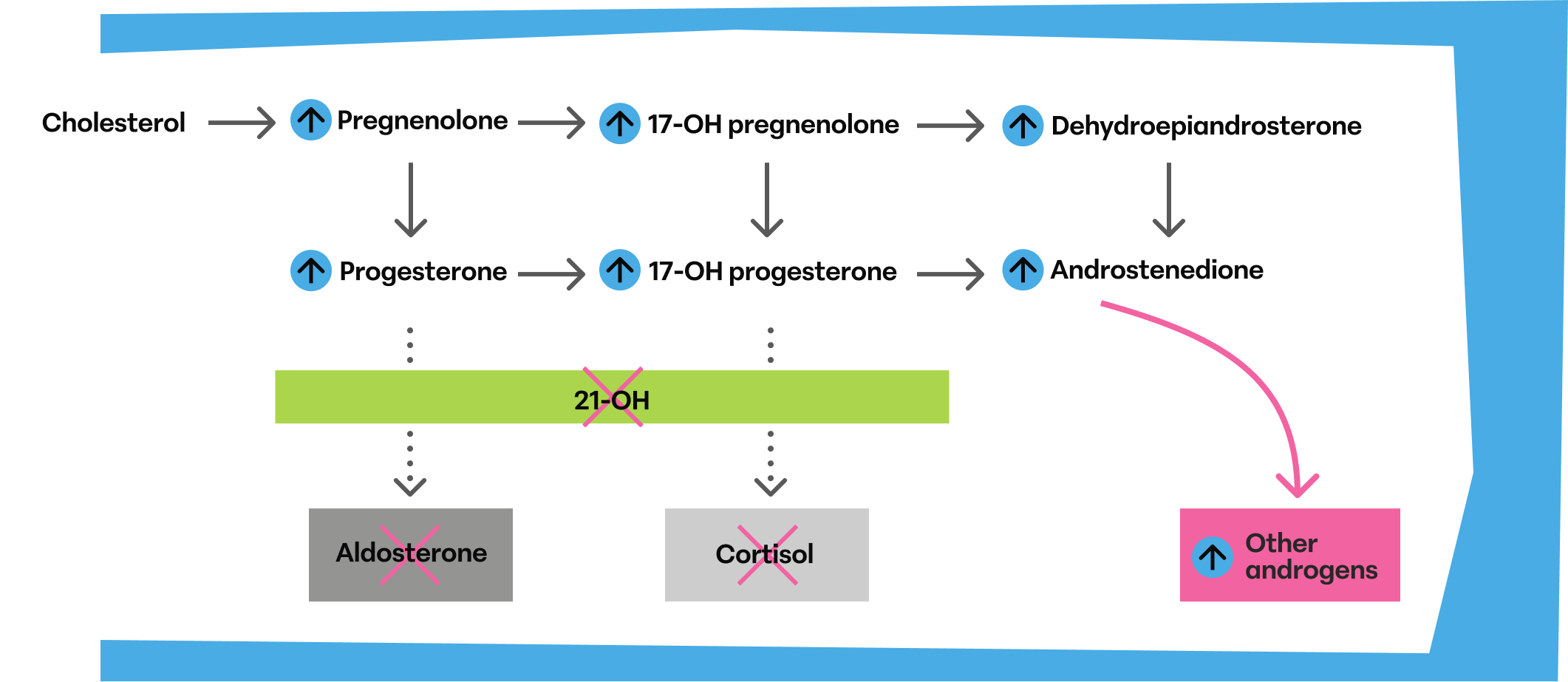
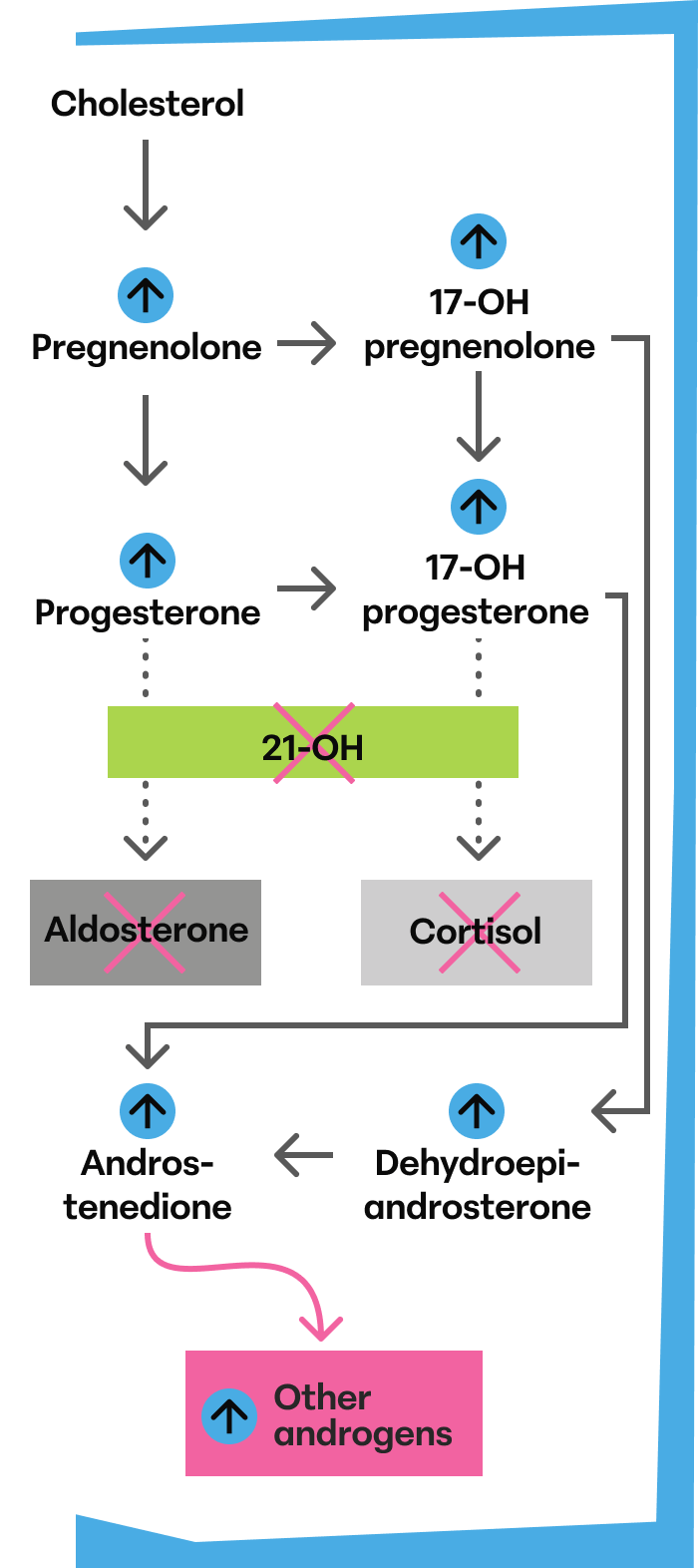
Steroidogen-esis pathway shows that without 21-OH, excess precursors are shunted to androgen pathways1,8

Steroidogenesis pathway showing that without 21-OH, excess precursors are shunted to androgen pathwaysSteroidogenesis pathway showing that without 21-OH, excess precursors are shunted to androgen pathways

These hormonal deficiencies and excesses may lead to a wide range of symptoms that can affect all life stages4,9

Do you associate CAH more with cortisol deficiency or androgen excess?

View results

See the effects of high androgen levels on patients at various life stages2,4,8-11
Learn about excess androgens

Explore the CRF pathway

Learn about CRF1 receptors

REFERENCES

  1. Mallappa A, Merke DP. Management challenges and therapeutic advances in congenital adrenal hyperplasia. Nat Rev Endocrinol. 2022;18(6):337-352. doi:10.1038/s41574-022-00655-w
  2. Speiser PW, Arlt W, Auchus RJ, et al. Congenital adrenal hyperplasia due to steroid 21-hydroxylase deficiency: an Endocrine Society clinical practice guideline. J Clin Endocrinol Metab. 2018;103(11):4043-4088. doi:10.1210/jc.2018-01865
  3. Auer MK, Nordenström A, Lajic S, Reisch N. Congenital adrenal hyperplasia. Lancet. 2023;401(10372):227-244. doi:10.1016/S0140-6736(22)01330-7
  4. Merke DP, Auchus RJ. Congenital adrenal hyperplasia due to 21-hydroxylase deficiency. N Engl J Med. 2020;383(13):1248-1261. doi:10.1056/NEJMra1909786
  5. Bialk ER, Lasarev MR, Held PK. Wisconsin's screening algorithm for the identification of newborns with congenital adrenal hyperplasia. Int J Neonatal Screen. 2019;5(3):33. doi:10.3390/ijns5030033
  6. Sarafoglou K, Banks K, Kyllo J, Pittock S, Thomas W. Cases of congenital adrenal hyperplasia missed by newborn screening in Minnesota. JAMA. 2012;307(22):2371-2374. doi:10.1001/jama.2012.5281
  7. Schröder MAM, Claahsen-van der Grinten HL. Novel treatments for congenital adrenal hyperplasia. Rev Endocr Metab Disord. 2022;23(3):631-645. doi:10.1007/s11154-022-09717-w
  8. Hindmarsh PC, Geertsma K. Congenital Adrenal Hyperplasia: A Comprehensive Guide. Elsevier/Academic Press; 2017.
  9. Prete A, Auchus RJ, Ross RJ. Clinical advances in the pharmacotherapy of congenital adrenal hyperplasia. Eur J Endocrinol. 2022;186(1):R1-R14. doi:10.1530/EJE-21-0794
  10. Sarafoglou K, Merke DP, Reisch N, Claahsen-van der Grinten H, Falhammar H, Auchus RJ. Interpretation of steroid biomarkers in 21-hydroxylase deficiency and their use in disease management. J Clin Endocrinol Metab. 2023;108(9):2154-2175. doi:10.1210/clinem/dgad134
  11. Koren R, Koren S, Khashper A, Benbassat C, Pekar-Zlotin M, Vaknin Z. Ovarian adrenal rest tumor in congenital adrenal hyperplasia: is medical treatment the first line option? Arch Endocrinol Metab. 2021;65(6):841-884. doi:10.20945/2359-3997000000415