

See what makes treating CAH with GCs alone so complex3
Results from a longitudinal NIH study reveal increased hypertension (stages 1 and 2), insulin resistance, and obesity in those with CAH treated with GCs alone to manage androgens.1*
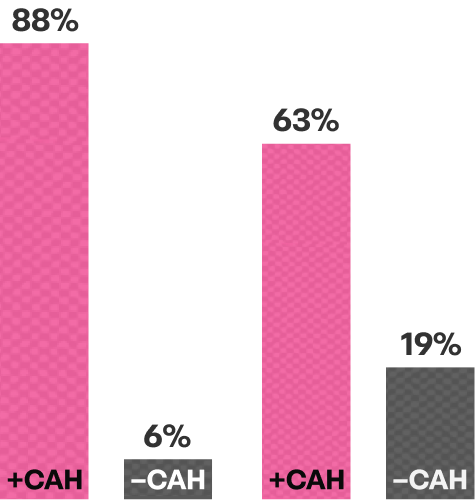
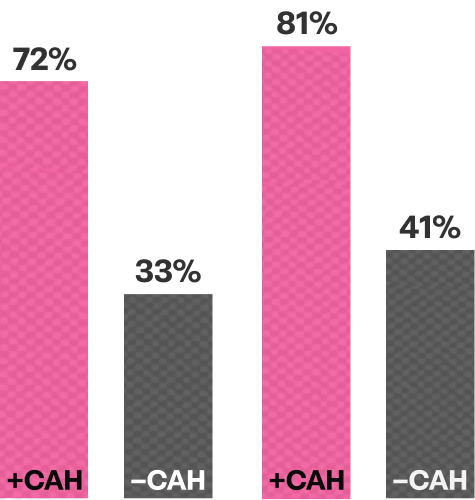
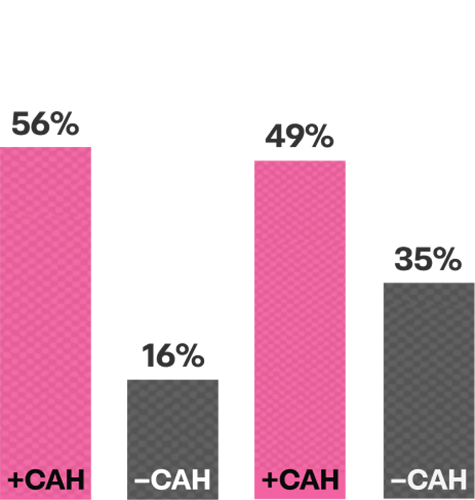

*The study compared patients with CAH (n=57) with age- and sex-matched US population controls over at least a 5-year period that spanned childhood and adulthood. The adult population included patients aged 18-39 years. The average GC dose was ~17.6 mg/day in hydrocortisone equivalents.1
†+CAH indicates patients with CAH. –CAH indicates patients without CAH.
‡Obesity was defined as BMI ≥95th percentile during childhood or BMI ≥30 kg/m2 during adulthood.1
BMI=body mass index; NIH=National Institutes of Health.
Length: 03:22
INTRO SUPER: Expert Insights on Congenital Adrenal Hyperplasia
SUPER: Balancing Excess Androgens and Glucocorticoids as a Pediatric Endocrinologist
SUPER: Dr. Ahmed Khattab, Pediatric Endocrinologist, Rutgers Robert Wood Johnson Medical School
[Dr. Khattab]
I'm Doctor Ahmed Khattab. I'm a pediatric endocrinologist in the Division of Pediatric Endocrinology at Rutgers Robert Wood Johnson Medical School.
I'm an associate professor of pediatrics in the Division of Pediatric Endocrinology, and I'm the director of Comprehensive Care Center of the Center of Excellence for Congenital Adrenal Hyperplasia (CAH), which is the only center in New Jersey.
I've been in medical practice for over 20 years, with about 15 years of them focusing in the area of adrenal endocrinology.
We do educate the patients and the caregivers about the certain side effects, or the symptoms and signs to look for, whether it's related to excess glucocorticoid administration or due to excess androgens. We try to tell them you would look for a rapid growth rate, for example, with excess androgens, or if you're undertreated, you would look for a slow growth rate.
We demonstrate this by showing patients the growth chart. We talk to our patients about the energy level. If the energy level is very low this may be related to very little glucocorticoid in the system.
Recognizing the signs and symptoms of glucocorticoid excess or androgen excess are very important in the management of CAH.
SUPER: Recognizing Signs of Androgen and Glucocorticoid Excess
[Dr. Khattab]
We try to talk to the patients about other signs that are very specific to excess androgens such as facial hair in women or females, irregular menstrual cycles, increased acne, body hair, hair loss, skin darkening or hyperpigmentation. Signs of excess glucocorticoids or overtreatment may indicate a lot of weight gain, headaches, high blood pressure, and slowed growth.
SUPER: Addressing Long-Term Risks of Supraphysiologic High-Dose Glucocorticoid Use
[Dr. Khattab]
We explain that we're trying to achieve a balance between the glucocorticoid administration and the actual control of CAH.
We make sure our patients are informed of the potential side effects of glucocorticoids in the acute stage and on the chronic stage or on the long term.
Patients and caregivers do acknowledge the importance of treatment and the importance of glucocorticoid administration, namely, that this is a potentially fatal condition. So, we must use glucocorticoids to treat the patients.
We talk to all our patients about healthy eating habits, the importance of avoiding weight gain, which will further contribute to obesity, insulin resistance, hypertension, and other comorbid conditions.
We talk to our male patients about the importance of testicular ultrasounds to evaluate for testicular rest tumors.
There's always glucocorticoid associated comorbidities in CAH, so being able to reduce the amount of glucocorticoids administered to these patients and hopefully trying to administer more physiologic glucocorticoids to these patients will be associated with a better disease outcome.
SUPER: Learn more at WhatTheCAH.com/HCP
See what makes treating CAH with GCs alone so complex3

REFERENCES